Foaling
Over the past decade we have learned a few things about the foaling process and thought it would be good to share what we have learned. Donkeys’ gestation is typically 12 to 13 months, when a jennet is close to foaling, she will be “bagged” up with the nipples being full of milk. Some breeders will suggest extracting some of the milk to allow the color of the milk to determine approximate foaling times. We have never done this and do not recommend this as there is a waxlike plug the develops on the nipples to help keep out bacteria until the foal is ready to nurse. Also, the momma’s colostrum milk is the most important milk that a foal needs within the first 24 hours to help sustain proper nutrition and boost the foals weakened immune system after birth. This first milk is precious, and we do not want to waste it. There are many other ways to tell how close a jenny is to foaling that only involves visual observation. We have developed a unique skill that has allowed us to estimate foaling times within a few hours by looking and feeling the bag and nipples, feeling how loose the tail and back end is, and how loose and red the jenny’s vulva is. All of these things allow you to estimate delivery time, but with live animals nothing is an exact science as we have been surprised with a foal that we were not expecting before.
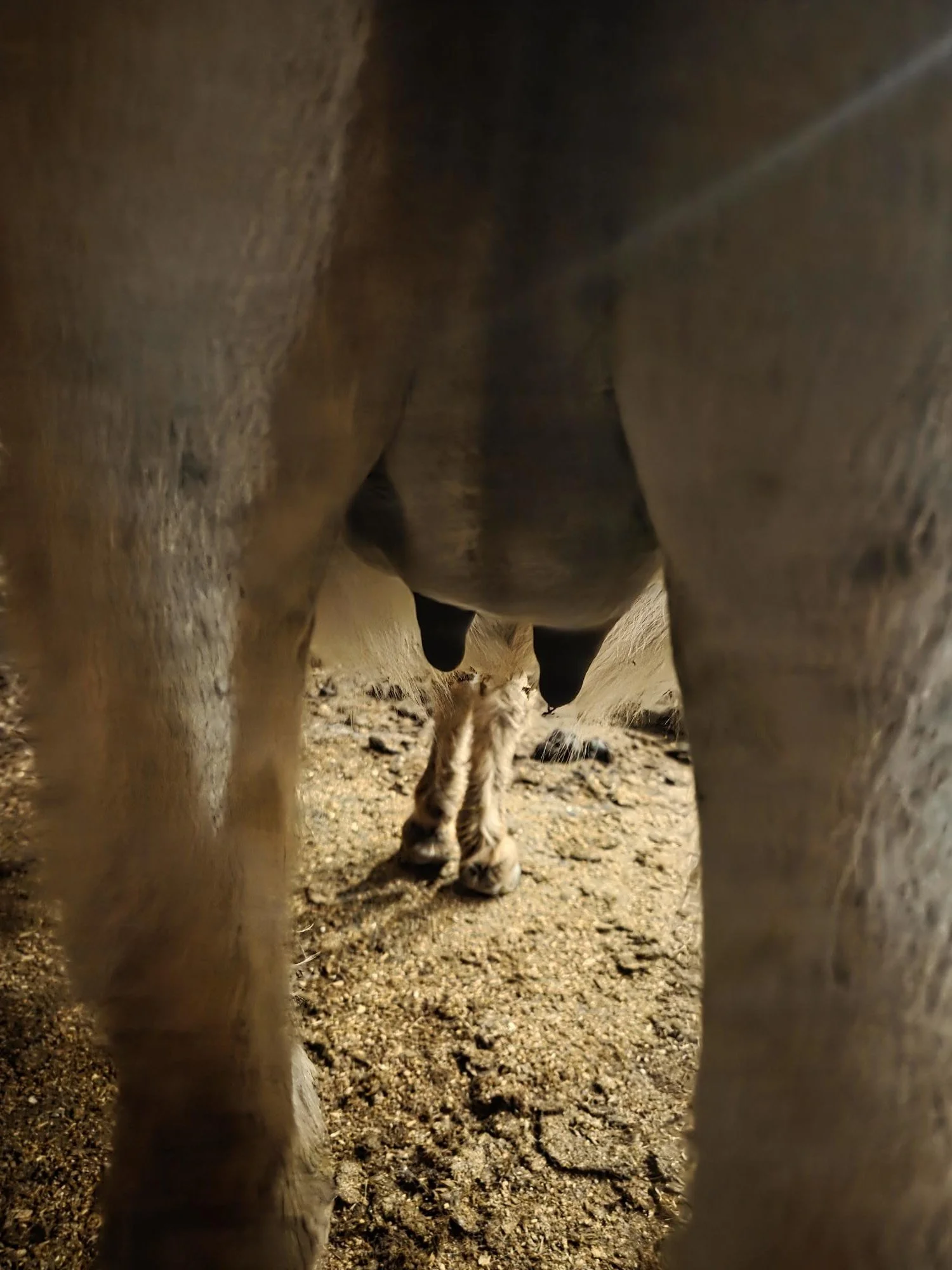
Picture of a Jenny that has bagged up but is not yet ready to foal. While the bag is full the nipples are not full and they are not pointing in opposite directions of each other.
Once the Jenny starts to go into labor she will be laying down in the field sometimes rolling but mostly chooses one side to lay on with all four feet typically straight out during the pushing process. The Jenny will continue to push and often get up and down during the delivery process. You typically do not need to assist in a normal delivery and can watch from a distance. In a normal delivery the process should last between 30 and 45 minutes. Labor lasting longer than that should have veterinary assistance. Within the first 10 minutes of delivery, you should see two hooves followed shortly by the foal’s nose. This is crucial to know that the foal is positioned correctly for a normal delivery. Unnecessary assistance in delivering the foal like helping pull the foal out on a normal delivery can interrupt the natural squeezing process that a foal needs to undergo to stimulate its brain to wake up out of a stoic state. Foals have slippers on their hooves when they are first born that helps protect the jenny’s birth canal during the birthing process. These slippers generally fall off within the first few hours after delivery.
After delivery we typically take momma and baby to a separate stall where they can have privacy and can be observed closely to determine if the foal is nursing. Nursing should take place within the first few hours after delivery this is crucial in the foal getting the nutrients it needs to survive. During this time, it is also crucial to make sure the momma’s placenta has been fully passed. Sometimes the placenta will come out with the foal during the delivery and other times the foal will be detached from the placenta, and the placenta remains inside the Jenny. If this happens you can either let the Jenny pass the placenta on her own, or what we do is provide slight gentle pressure down and out to help coax the placenta out to make the nursing process for the foal easier. Some of our foals have even had the placenta/ cord attached to their belly after delivery. This is rare but can happen and is okay to clamp it off and cut the cord before the clamp.
Foals only need a few hours after birth to be aware, walking, and nursing. If a foal fails to stand up, isn’t actively searching for milk, acts dazed or confused and disassociates with the Jennet, it could be a sign of a serious condition called dummy foal syndrome. In our 10 years of having foals, we have had this happen once to one of our foals. The good news is there is a procedure that you can do with a rope at least a ¼ inch in size and about 8 to 10 feet in length. When I needed to find one, I was not prepared and ended up using a nylon docking anchor line I had for my boat. The procedure is called the Madigan Squeeze. I positioned this rope around the foal and conducted the squeeze technique and after about two minutes the foal stood up and stared trying to suck my nose. It quickly found mom and started searching for milk. This foal made a full recovery and was perfectly fine.
So, what is Dummy Foal Syndrome? After doing research after fact, I learned that in some deliveries the foal passes through the birth canal rather easily, too easily, and the body of the foal is not squeezed long enough to trigger the neurological response in the foal that tells the foal to wake up or know that it was born. The foal stays in a womb-like sleep state. The Madigan Squeeze is neurological reset that transitions Neonatal Maladjustment foals into full alertness and encourages nursing.
If during the delivery process something seems off, we always recommend calling your veterinary early as in most cases every second counts when trying to save a struggling foal/jenny. Developing a good relationship with your vet is vital in these moments.